The One Pixel Camera
The One Pixel Camera is a conceptual project involving aspects of photography, sculpture, electronic design and performance serving as an inquiry into the nature of the digital photographic medium: specifically questioning the connection between the digital photographic image and the reality that the camera records.
Taking a first principles approach, The One Pixel Camera reduces the camera’s function down to its primary essence: a mere capture (index) of light. For the project, a camera was specifically designed and constructed so that it can perform no more than this essential function. Nothing but a quantifiable, data-point (pixel) of light information is recorded, and the operator has almost no subjective control in terms of the quality, framing or content of the image. The resultant captures in no way depict the details of the reality recorded, yet they still serve as images, and as documents, on some level.
Additionally, the absurd design magnifies, and makes obvious, the design limitations and rules by which one is bound through the design (program) of the camera. This works to reveal the hidden politics, as described by theorist such as Bruno Latour, Vilém Flusser and Langdon Winner, inherent to technological design and the ways in which design tacitly prescribes and dictates certain behaviours while restricting others.
The project exists as three main components: 1) The camera itself, which functions as a sculptural object or potentially an interactive artwork; 2) The images produced by the camera, labelled with explicit captions indicating their subject matter; and 3) Photographs of the camera in use as documentation of my “performing” the program of the camera. To date, I have been using the camera to produce a series of images depicting clichéd and conventional photographic subject matter, essentially “Kodak Moments”, such as sunsets, family events, outdoor activities, portraits, personal belongings, weddings, and tourist locations.
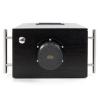 The One Pixel Camera (front view) - Wooden box, tripod mount, Zeiss lens, LCD viewfinder, custom electronics and software.
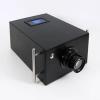 The One Pixel Camera (isometric view) - Wooden box, tripod mount, Zeiss lens, LCD viewfinder, custom electronics and software.
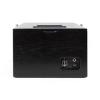 The One Pixel Camera (back view) - Wooden box, tripod mount, Zeiss lens, LCD viewfinder, custom electronics and software.
 The One Pixel Camera: Sunset at Grand Bend (2014) - One pixel Image, archival pigment print 15” x 15” (printed at 0.0667 pixels per inch).
 The One Pixel Camera: Giselle holding the fish she just caught (2014) - One pixel Image, archival pigment print 15” x 15” (printed at 0.0667 pixels per inch).
 The One Pixel Camera: Niagara Falls (2014) - One pixel Image, archival pigment print 15” x 15” (printed at 0.0667 pixels per inch).
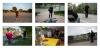 Documentation of The One Pixel Camera in use -
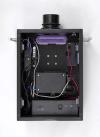 The One Pixel Camera (internal view) - Internal Components: 1) An industrial colour sensor, 2) A Zeiss lens from an old process camera, 3) Ground-glass for “image” formation, 4) A microcontroller programmed to acquire sensor data, 5) A miniature Linux-based computer that runs the python code which functions as an operating platform for the camera, 6) A small flat-screen display to act as viewfinder and interface, 7) A speaker to produce an audible “click”, 8) A circuit for power distribution, 9) A battery for untethered use in the field.
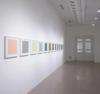 The One Pixel Camera - Installation at the McIntosh gallery for The Things You Know but Cannot Explain exhibition.
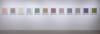 The One Pixel Camera - Installation at the McIntosh gallery for The Things You Know but Cannot Explain exhibition.